NATIONAL CLIMATE ACTION

Brunei Darussalam National Climate Change Policy (BNCCP)

In 2020, the BNCCP was launched to provide strategic direction to achieve Brunei Darussalam’s Nationally Determined Contribution (NDC). It outlines 10 key strategies across addressing Mitigation, Adaptation, and Enablers to shape the country 
towards becoming a sustainable, low-carbon, and climate-resilient country.

Review in Progress

The BNCCP is currently being updated to ensure that Brunei Darussalam’s climate policy framework remains relevant, realistic, and effective in addressing current and future climate challenges.

BNCCP Strategies (2020)

Strategy 1: Reduce Industrial Emissions

Reduce overall greenhouse gas emissions from the industrial sector through zero routine flaring and to As-Low-As-Reasonably-Practicable (ALARP).

Strategy 2: Increase Forest Cover

Increase carbon sink through afforestation and reforestation with a target of planting 500,000 new trees.

Strategy 3: Electric Vehicles

Increase total share of electric vehicles to 60% of total annual vehicle sales.

Strategy 4: Renewable Energy

Increase the total share of renewable energy to at least 30% of total capacity in the power generation mix.

Strategy 5: Power Management

Reduce greenhouse gas emissions by at least 10% through better supply and demand management of electricity consumption.

Strategy 6: Carbon Pricing

Impose price on carbon emissions.

Strategy 7: Waste Management

Reduce municipal waste to landfills to 1kg/person/day.

Strategy 8: Adaptation and Resilience

To strengthen Brunei Darussalam’s resilience to climate change risks and increase its ability to reduce its vulnerability to the impacts of climate change.

Strategy 9: Carbon Inventory

To strengthen the national greenhouse gas inventory by monitoring all greenhouse gas emission and removal calculation activities, and ensuring that the national greenhouse gas inventory is transparent, complete, consistent, comparable, and accurate.

Strategy 10: Awareness and Education

Increase awareness and education surrounding mitigation and adaptation responses against climate change.

National Adaptation Plan (NAP)

  • Live document outlining response and implementation measures to preemptively prepare against climate vulnerabilities and risks in Brunei Darussalam.
  • It serves as a national guide to navigating climate change challenges, ensuring the continued resilience and prosperity of communities, ecosystems, and the economy.
  • The document reflects the country’s commitments as a Party to the Paris Agreement, particularly to enhance adaptive capacity, strengthen resilience, and reduce vulnerability to the impacts of climate change.
  • To support the NAP, the country is also conducting a National Climate Vulnerability Assessment (NCVA), which aims to further assess the vulnerability of the country to ensure that adaptation strategies are always responsive, appropriate, and effective.
  •  

Directive on Mandatory Reporting on Greenhouse Gases (MRD)

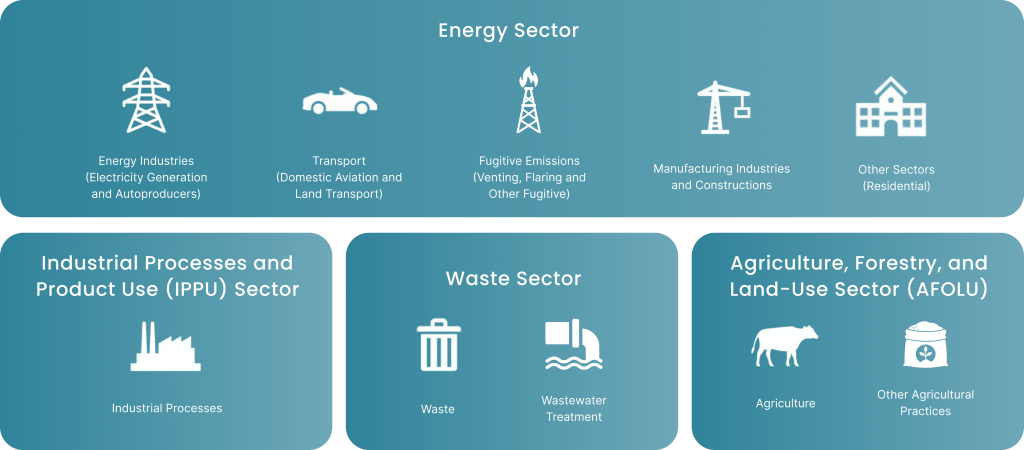
  • Mandates all facilities in the activity chain that emit and remove greenhouse gas emissions to report quarterly and annually, ensuring Transparency, Comparability, Completeness, Consistency, and Accuracy (TCCCA) of our Data. 

This involves government departments and private sector companies from 4 sectors:

Current Status

  • BCCO has assessed the progress made since the introduction of the Directive, following the end of the grace period in March 2025. Significant improvements include the use of more standardised reporting templates, increased technical capacity, and better coordination between implementing agencies.
  • This strengthening of the inventory has also been reported in the mandatory reporting to the UNFCCC, the 1st Biennial Transparency Report (BTR1), thus demonstrating progress in the transparency and reliability of emissions data.

Protokol Hijau

English Version

Malay Version

Protokol Hijau, launched in January 2021 is a guideline to reduce greenhouse gas emissions across public service premises in Brunei Darussalam:

  • It outlines the steps that need to be implemented in such a way that the Government could be the best example to achieve the national target set out by the BNCCP.
  • The government sector contributes an estimated 23% of total national GHG emissions, electricity consumption, and as much as 25% of total national water consumption as a whole.
  • 7 important elements are considered:

Energy Usage

Water Usage

Paper Usage

Plastic Usage

Solid Waste Disposal

Management of Official Events

Tree-Planting